Professional bakeries operate very differently from home kitchens. Dough is mixed in much larger batches, equipment runs for hours at a time and production needs to stay consistent throughout the day.
In this guide, we’ll look at the professional bakery equipment and tools commonly used in commercial bakeries and explain how each one fits into the day-to-day baking process.
What Is the Difference Between Commercial and Home Baking Equipment?
Home baking equipment, whether it’s used to bake for fun or a business, is designed on a much smaller scale than commercial baking equipment. Home mixers, ovens and baking tools are used to bake a low volume of cookies or bread loaves, enough for your friends and family or small orders.
Professional bakery equipment, like the machines we supply at Creeds Direct, is built for high-volume use and continuous operations in busy bakeries or kitchens.
What Machines Do You Need in a Professional Bakery?
To run a functional and successful bakery, the checklist of machines might look straightforward on paper, but each piece of equipment plays a specific role in the workflow. After all, in a professional setting, you’re repeating a process reliably, day after day.
Here are the core machines most commercial bakeries will have:
Commercial bakery ovens – for consistent heat and capacity
Dough mixers – to develop gluten and combine ingredients efficiently
Dough dividers and rounders – to portion dough accurately
Pastry sheeters – for rolling and laminating dough with precision
Bread slicers – to slice loaves quickly and uniformly
Alongside these core machines, many bakeries invest in more specialised equipment depending on the products they produce.
For example, bakeries that focus on particular products may use machines such as the following:
Bagel moulders for shaping bagels quickly and consistently
Baguette slicers designed for long artisan loaves
Doughnut fryers for producing fresh doughnuts in larger batches
Pizza ovens for bakeries that also offer pizza or flatbreads
The type of bakery you run will often determine which machines make the most sense. An artisan bread bakery, for example, will prioritise ovens and mixers.
Bakery Ovens
If there is one piece of equipment no bakery can operate without, it’s an oven. These machines take raw dough and batter and transform them into the baked goods that fulfil your customers and your business’s needs.
Professional bakery ovens are designed and built to keep up with high daily production levels. They must be reliable and have accurate temperature control; otherwise, they will deliver inconsistent results.
Their features are far more advanced than home ovens. Commercial bakery ovens are
- Designed for continuous use
- Able to inject steam into the baking chambers
- Allow multiple trays or full racks to be baked at once
- Increased heat control
Types of Bakery Ovens Used in Commercial Bakeries
There are three main types of ovens that are ideal for busy bakeries: deck ovens, convection ovens and rack ovens.
Deck Ovens
Deck ovens remain a favourite among artisan bakeries and bread specialists.
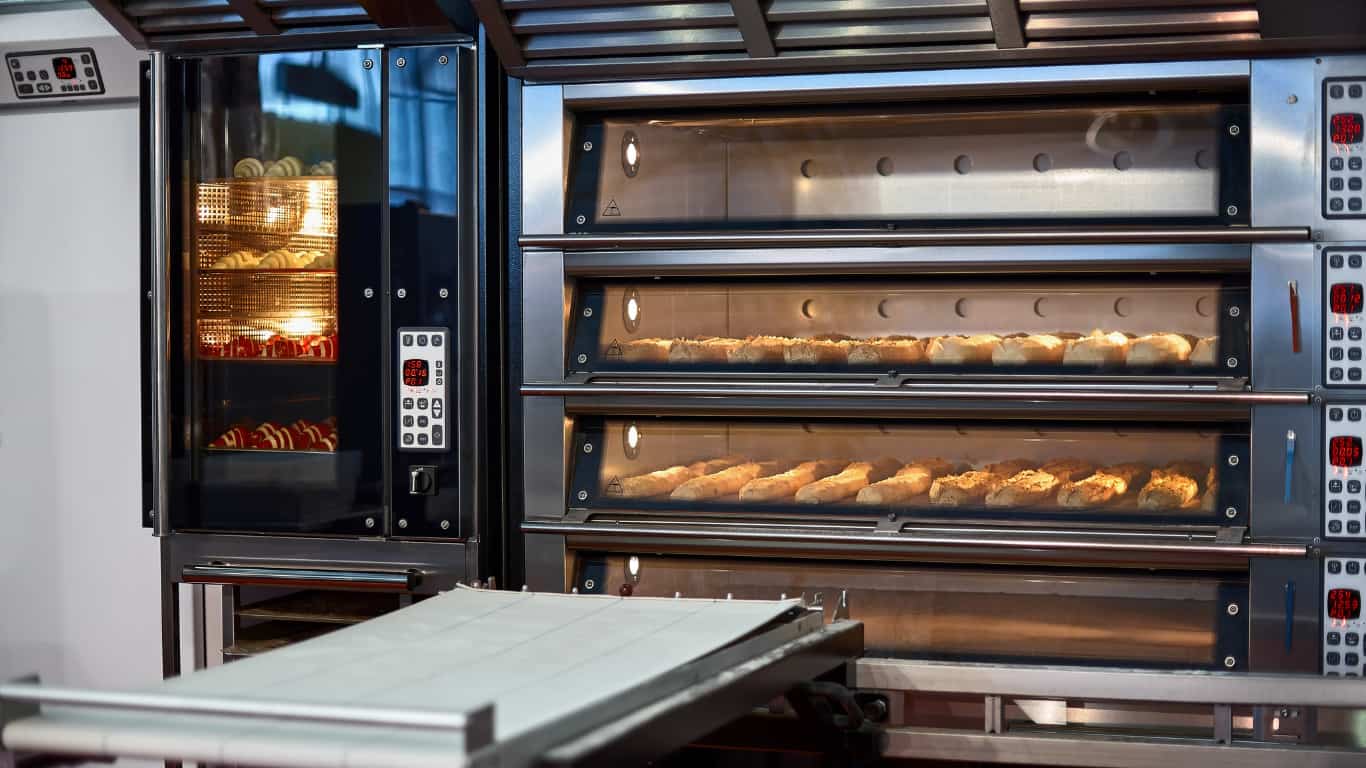
These ovens have multiple baking chambers that can be controlled individually. Built with advanced technology, they hold heat extremely well. This stored heat helps create strong oven spring and crisp crusts, particularly important for sourdough and crusty bread.
Deck ovens can consist of modular decks giving the bakery the possibility of adding further decks if their production increases. Modular decks are also of interest if the bakery owners plan to eventually move to other premises, as they are easy to dismantle and re-assemble elsewhere.
Convection Ovens
Convection ovens are smaller and circulate hot air around the baking chamber using internal fans.
This airflow helps produce even baking across multiple trays. They are commonly used for cakes, pastries, biscuits and tray bakes.
Many cafés and bakery shops rely on convection ovens because they are compact and versatile.
Rack Ovens
A rack oven is the best for bakeries that have a high output. They accommodate racks that hold multiple trays. This allows you to bake dozens of trays of products at once, making them ideal for larger wholesale bakeries with a high production demand.
Dough Mixers
Mixing is one of the most important stages in bread-making.
The way dough is mixed affects gluten development, dough temperature and fermentation behaviour. Getting that balance right is difficult without the right equipment.
Commercial dough mixers allow bakeries to handle large dough batches quickly while maintaining consistent results.
Types of Mixers Used in Bakeries
Spiral mixers
Spiral mixers are widely used in bread bakeries.
The spiral hook turns while the bowl rotates, allowing the dough to develop gradually. This motion is gentle on the dough and helps prevent overheating.
They are particularly well suited for bread dough with higher hydration levels.
Planetary mixers
Planetary mixers are commonly found in bakeries that produce a wide range of products.
The mixing tool rotates around the bowl, similar to a domestic stand mixer but on a much larger scale. Different attachments allow the machine to mix dough, cake batter, creams and fillings.
Heated Mixers
Heated mixers heat and mix simultaneously.
The machine can be used for a wide variety of products in bakeries, including cooking creams, custards, fruits, vegetables, soups and fondants and for melting chocolates.
Dough Dividers and Rounders
Dough dividers and rounders are essential pieces of professional bakery equipment that help high-output bakeries save time and improve efficiency. These machines divide large batches of dough into evenly weighed portions and shape them into uniform balls, ready for proofing or baking.
In small bakeries this is sometimes done manually, but once production increases, it can be time consuming. By automating this process, you save time and can maintain consistent product sizes.
Dividers can also be paired with dough-rounder machines.
Rounders shape dough portions into smooth balls, preparing them for moulding or final shaping. In busy bakeries producing hundreds of loaves or rolls each day, dividing and rounding equipment can dramatically speed up production.
Pastry Sheeters
Working with pastry relies on getting the thickness precisely correct. Pastry sheeters speed up and simplify the process by rolling dough out evenly between adjustable rollers. These machines work well with the following:
- Croissants
- Danish pastries
- Shortcrust pastry
- Puff pastry
By passing dough repeatedly through the rollers with butter layers folded in between, bakers can build the laminated structure needed for flaky pastry.
In busy bakeries, a good sheeter can save hours of manual rolling each day.
Proofing Cabinets
Once the dough has been shaped, it needs time to rise before baking.
This stage is known as proofing.
Proofing cabinets provide a controlled environment where temperature and humidity can be carefully regulated. This allows yeast fermentation to take place at a steady rate.
Without controlled proofing conditions, rising times can vary widely depending on room temperature. In colder kitchens especially, dough may take much longer to rise.
Proofing cabinets help bakeries maintain a predictable production schedule by keeping dough at the right conditions for fermentation.
Retarder-proofers are proofers which can be programmed to slow down the fermentation process. They cool the atmosphere inside the cabinet or the chamber, and then restart it at a convenient time for the dough products to be ready for baking in the morning. This type of equipment gives bakers much more comfortable working hours as they can prepare the dough at the end of the afternoon and program it to be ready for baking in the morning, thus avoiding the need to start work very early in the morning.
Bread Slicers
Once bread has cooled, it often needs slicing before being sold or packaged.
A commercial bread slicer allows bakers to slice whole loaves quickly into evenly sized slices. Bread slicers work by passing the loaf through a row of parallel blades. The spacing between blades determines the slice thickness.
Typically slice thicknesses can include 12 mm sandwich bread slices, 16mm “thick” slices, or even 18mm “door-step” slices.
- In smaller bakeries, manual slicers are often enough for daily production, whilst larger bakeries benefit more from using automatic slicers capable of processing hundreds of loaves per hour.
What Bakery Tools and Utensils Do You Need in a Professional Bakery?
Smaller tools and utensils are the tools bakers reach for throughout the day while mixing, shaping and finishing products.
Good bakery tools need to be durable, easy to clean and comfortable to use during long shifts. In a bakery, even simple tools like dough scrapers and pastry brushes get used hundreds of times a day.
Below are some of the most commonly used tools found in professional bakeries.
Measuring and Weighing Tools
The accuracy of weighing ingredients is critical in baking. Small variations in ingredient weight can affect dough hydration, fermentation and the final texture of the product.
For that reason, professional bakeries rely heavily on scales rather than volume measurements.
Typical measuring tools include the following:
- Digital bakery scales
- Dough thermometers
- Measuring jugs
- Ingredient scoops
Dough Handling Tools
During shaping and preparation, bakers rely on a number of simple but essential bench tools.
These include:
- Dough scrapers
- Dough knives
- Plastic bowl scrapers
Scotch scrapers are particularly useful when working with sticky doughs. They help bakers divide dough cleanly and keep the work surface tidy.
Mixing and Preparation Tools
While mixers handle large batches, many ingredients still need to be mixed or folded by hand.
Common mixing and preparation tools in a bakery include:
- Whisks
- Mixing bowls
- Spatulas
Flexible spatulas are widely used for scraping bowls clean and for folding ingredients.
Pastry and Finishing Tools
Pastry production often requires more detailed finishing work.
Tools used during this stage include:
- Pastry brushes for egg wash.
- Rolling pins.
- Pastry wheels.
- Decorating tools including piping equipment.
Pastry brushes are particularly important for applying egg wash evenly before baking, helping pastries develop their characteristic golden colour.
Bakeware and Baking Trays
Bakeware determines the shape, structure and finish of many baked products.
Professional bakeries use a wide range of trays and moulds depending on the type of product being made. Choosing the right bakeware ensures products bake evenly and release easily once cooled.
Bread Tins
Bread tins are commonly used for sandwich loaves and other pan breads.
They help dough maintain its shape during baking and result in uniform slices once the loaf is cut.
Cake Tins and Moulds
Cake tins come in a range of shapes and sizes depending on the product.
Professional bakeries often rely on aluminium tins because they conduct heat evenly and withstand frequent use.
Storage and Ingredient Handling Equipment
Flour, sugar, butter and other ingredients used daily in bakeries need to be stored safely and kept easily accessible during production. Bakeries should invest in adequate storage which could include ingredient bins, bakery shelving or racks and cold storage.
Ingredient Bins
Large ingredient bins are commonly used for storing flour and sugar. These bins help protect ingredients from contamination while making it easier to scoop or weigh out large quantities.
Bakery Shelving
Strong shelving systems allow bakeries to store trays, equipment and ingredients efficiently.
Refrigeration and Cold Storage
Many bakery ingredients require refrigeration. Cold storage is used for:
- butter
- cream
- fillings
- prepared dough
Maintaining proper storage conditions helps extend shelf life and maintain the quality of your ingredients.
How to Choose the Right Bakery Equipment for Your Business
Every bakery operates differently, so the equipment required can vary depending on the type of products being made and the scale of production.
When selecting professional bakery equipment, several factors are worth considering, such as your production volume, kitchen space, durability and how easy the equipment is to maintain and clean.
Production volume
A small artisan bakery producing a few hundred loaves a day will have very different equipment needs compared to a large wholesale bakery.
Choosing equipment with the right capacity ensures production can keep up with demand.
Available kitchen space
Commercial bakery equipment can take up significant space in your kitchen.
Before purchasing new machines, it’s important to consider how they will fit into the existing kitchen layout and workflow.
Durability and reliability
Bakery equipment often runs for many hours each day.
Machines built for commercial use tend to be more durable and capable of handling the demands of daily production.
Ease of cleaning and maintenance
Equipment that is easy to clean and maintain saves time and keeps your baking processes more efficient.
Regular maintenance also helps extend the lifespan of machinery.
Professional Bakery Equipment at Creeds Direct
Choosing the right supplier matters just as much as choosing the equipment itself.
At Creeds Direct, we have been supplying professional bakery equipment to the industry for more than 50 years. We work with artisan bakeries, foodservice kitchens and large-scale production facilities across the UK, providing machines and tools that are built for real bakery environments.
Our range covers the full spectrum of bakery equipment, and all equipment is sourced from trusted manufacturers with a proven reputation in the baking industry.
One thing that sets us apart at Creeds Direct is the knowledge behind the business. Our team includes former professional bakers who understand how equipment performs in a real bakery setting.
If you are opening a new bakery, expanding production or replacing older machinery, contact us today for expert advice and recommendations.